
Doctrine ·
The Schlieffen Delusion
Schlieffen's plan to knock France out in a month and pivot to Russia ignored the enemy's vote, the logistics, and the leadership it would need. The chain of failures that started the Great War.
By The Captain
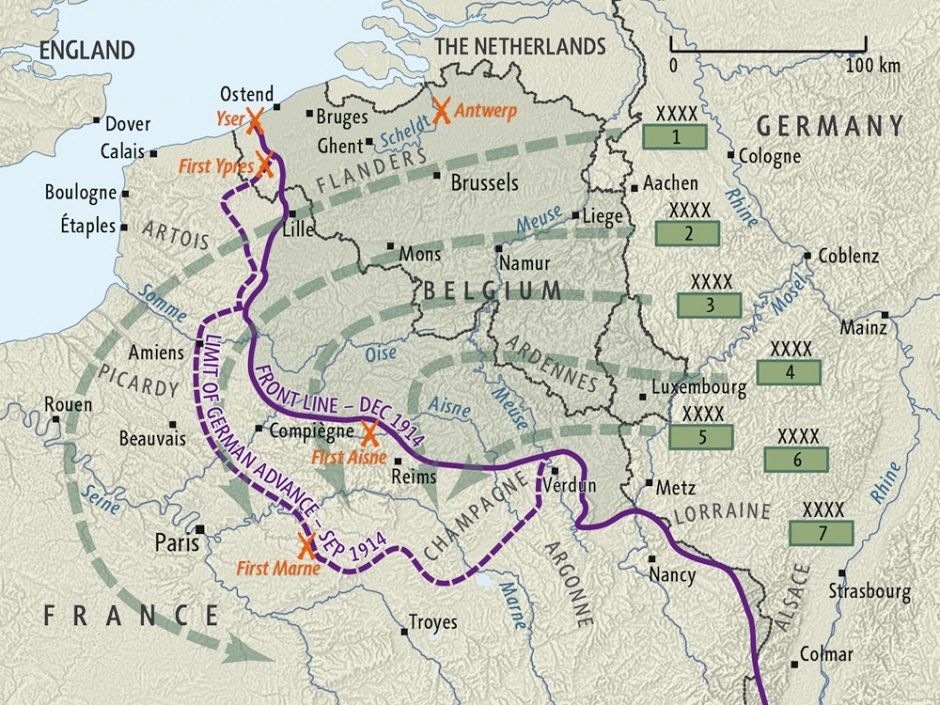
By the end of 1907, Germany began to feel closed in as Russia, France, and Great Britain had formed what became known as the Triple Entente, and it made Kaiser Wilhelm II nervous. German war planners began looking at the problem, which led Field Marshal Count Alfred von Schlieffen to propose an ambitious plan to counter this threat. His plan was to hit the French Army first, destroy them quickly before the Russian Army fully mobilized, then send divisions to fight the Russians. On paper, it looked like a brilliant plan. In reality, it was doomed to fail before it started.
The first major flaw in the problem was that Schlieffen made an assumption that it would take at least a month for the Russian Army to be fully mobilized and ready to fight. Therefore, Schlieffen called for the defeat of the French Army within that time frame so that they could turn their attention to Russia. This was an unrealistic timetable and would bite the Germans in 1914.
Heavy defenses designed to repel any attack from the German Army lined the French border with Germany. Schlieffen understood this and knew that it would take many months to dislodge the French from this defensive line. The only way to keep his timetable would be to bypass these defensive positions. Schlieffen designated 5 Reserve Corps to hold the French forces in their fortified positions. Depending upon the circumstances, these units were to either attack Nancy to hold the French’s attention or, if the French attacked, fall back, drawing the French army after them. In the meantime, 34 Divisions consisting of 1.5 million soldiers were to sweep west through Belgium and the Netherlands, taking the strategic railway in Liège and charging toward Paris, enveloping the French Army and effectively crushing them.
That was the plan. Unfortunately, Schlieffen and his planners forgot that the enemy always gets a vote. They made ridiculous assumptions about the resistance from the Belgians and French. They also hoped that, even though Great Britain had a mutual assistance treaty with Belgium, they would ignore it and not join the fight. Even if they did, German arrogance did not worry about the small British army. In 1914, they would go to war with 150,000 men. These men however made up the only professional army in Europe at the time and were well trained.
They also did not account for the logistical issues that would come up. Germany had very few trucks, which meant that the massive army would have to be transported by rail, horse, and on foot. Also, due to budget restraints in the years prior to the war, important rail infrastructure was not finished in Germany. They also did not plan for the Belgians to tear up their tracks and destroy bridges as they retreated. These actions would slow their advance significantly.
Field Marshal Helmuth Johannes Ludwig von Moltke would replace Schlieffen as Chief of the Army General Staff. Once he took command, he would make modifications to the plan, weakening the strength of the sweeping right attack. He would also face problems with their Central Power ally Austria-Hungary. Austria-Hungary’s war plan against the Serbs in 1914 left the Russian border with Austria weakly defended, causing Moltke to assign valuable divisions to supplement their forces.
Von Moltke also knew that if the British did enter the war, their powerful navy would move to blockade Germany. He would also remove the invasion of the Netherlands, as they realized they would need them to import valuable goods to support their war machine as well as their civilian population. This would narrow his approach through Belgium, creating a choke point that would assist the Belgians’ defense.
Field Marshal von Moltke was not the best person to lead their army in executing Schlieffen’s plan. He was too easily swayed by his staff and lacked the confidence such a burden of command demands. This would lead to many mistakes and errors that would compound the flaws already inherent in the plan.
Henig’s assertions have merit; however, the ultimate flaw and failure of the Schlieffen Plan was the unrealistic timetable, lack of flexibility in the plan, and poor leadership from Field Marshal von Moltke. Though the plan looked good on paper, no plan survives first contact with the enemy, and it is incumbent upon leaders to empower their subordinate leaders to adapt to a situation and the army should have trained the plan themselves and with their allies.
Personally, I have enjoyed digging into this plan. One thing I always try to do is remember that they were still at the beginning of technology and abilities that we take for granted in today’s time. In some ways it isn’t fair to judge decisions of these war planners too harshly, as they were working with what they had at the time. Another thing I have always found interesting was how we still feel the effects of the war to this day as a result of the breakup of the Central Powers. I just never realized how poorly the Ottoman Empire was at this point in time. Well, thank you for reading this far, and I look forward to your comments and thoughts.
Bibliography
Groom, Winston. A Storm in Flanders. New York: Grove Press, 2002.
Holmes, Terence M. “Absolute Numbers: The Schlieffen Plan as a Critique of German Strategy in 1914.” War in History 21, no. 2 (2014): 193–213.
Kaiser, David E. “Germany and the Origins of the First World War.” The Journal of Modern History 55, no. 3 (1983): 442–74.
Van Evera, Stephen. “The Cult of the Offensive and the Origins of the First World War.” International Security 9, no. 1 (1984): 58–107.
Zuber, Terence. “The Schlieffen Plan Reconsidered.” War in History 6, no. 3 (1999): 262–305.
Originally published at the live site .