World War II · 1941 ·
Forgotten Valor: The Heroic Defense of Wake Island
For 14 days in December 1941, a handful of Marines, sailors, soldiers, and civilians held a tiny Pacific atoll against the Japanese Navy — and proved Japan was beatable.
- Outcome
- Tactical
- Belligerents
- United States vs. Empire of Japan
- Commanders
- James P. S. Devereux · Winfield Scott Cunningham · Paul A. Putnam · Henry T. 'Hank' Elrod · Sadamichi Kajioka
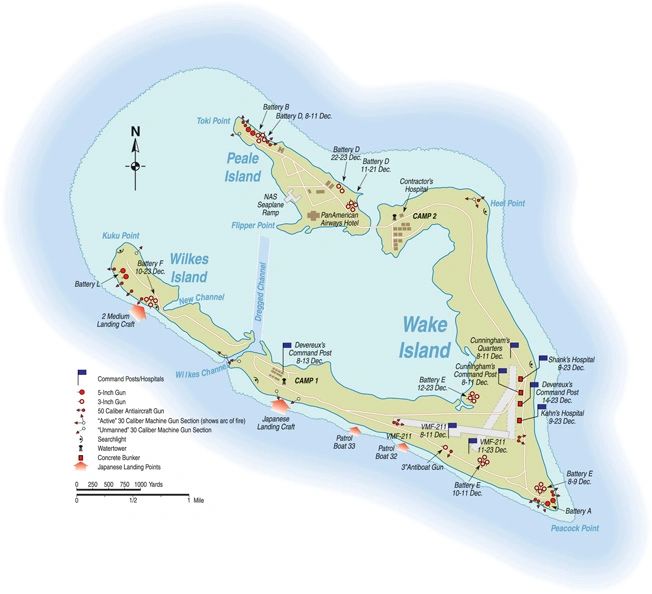
Wake Island Map: Explore the Battle of the Alamo in the Pacific
Greetings all! The Captain truly enjoys last stands and brave defense against overwhelming odds! Check out this one.
Introduction
“Wake Island, Wake Island, it’s not even marked on the map” is the chorus of a 1960s song by Oscar Brand. In the vast expanse of the Pacific Ocean, the little atoll of Wake Island — considered worthless since it was first discovered hundreds of years ago — was the setting of a brilliant last stand made by a handful of United States Marines, Sailors, Soldiers, and Civilians. Their bravery and resilience held the seemingly unstoppable Japanese Navy at bay for 14 days. Government bureaucracy and isolationist politics delayed the fortification of the tiny strategic island until it was too late. Wake Island was a valuable strategic asset and a vital stop for the Pan Am Clipper fleet. As tensions between America and Japan grew, the need of fortifying Wake grew. It was too little, too late.
The battle of Wake Island, fought between 8 December and 22 December 1941, stands as a testament to the unbreakable spirit and tenacity of the United States Marines and their civilian volunteers. Despite being outnumbered, outgunned, and desperately short of supplies, the defenders of Wake stopped the Japanese cold for fourteen days. This stand proved that America was not out of the fight and that Japan was beatable. The battle also highlighted the failures of the American government to prepare for the coming war while also giving the nation a critical morale boost.
Wake Island Overview
In October 1568, Spanish explorer Alvaro de Medana de Neyra stumbled upon a tiny atoll in the Pacific. De Neyra would dismiss it as useless and sail on. Then in 1796, the British ship Prince of Wales, commanded by Samuel Wake, would once again discover the tiny atoll and bestow the name Wake upon it. Once again, however, he deemed it desolate and useless and moved on. In 1841, a United States Navy sloop came upon the atoll once again and the crew would land on it and claim it for America.
Wake Island is a desolate and lonely place. It is a Pacific atoll made up of three islands located 2,004 miles west of Honolulu, 1,302 miles northeast of Guam, and 1,991 miles from Tokyo. The three islands are in a horseshoe shape and are the crown of a long-dead undersea volcano with a beautiful blue lagoon at its center. A barrier reef encircles Wake Island and is pounded by unpredictable currents and powerful surf. Pacific typhoons send tidal surges across the island, flooding it. The only approach to the island is possible in flat-bottom or extremely shallow-draft boats.
Area of Operations
Wake is strategically located in the Pacific. It sits 2,004 miles west of Honolulu, 1,302 miles northeast of Guam, and 1,991 miles from Tokyo. In 1935, Wake would become a key stop in Pan Am’s Trans-Pacific routes and built up facilities to service their Clipper Fleet, including a small resort for passengers to relax in between flights. These points made it a priority target for the Japanese planners as it would extend their defensive perimeter and prevent American raids on the Japanese bases throughout the Pacific. The War Department and the Navy set forth in building an air station on Wake in 1941 that could launch B-17s, fighters, and a seaplane base for the PBY Patrol aircraft.
Due to America’s isolationist stance and the state of the American military in 1940 and ‘41, there were many challenges to building the defenses on the various outlying island outposts like Wake. Among these were the lack of manpower and weapons needed for such a defensive plan.
On 8 January 1941, 80 civilian contractors led by Dan Teters landed on the atoll along with a cargo ship with a barge full of equipment. They set to work building the airstrip and supporting buildings and structures to house men and materiel. By the summer of 1941, the number of contractors on Wake Island would rise to 1,146. Contractually, however, building defensive positions such as bunkers and gun pits was not allowed. This would fall solely on the Marines.
These Marines of the 1st Marine Defense Battalion began arriving on the island in August of 1941. They set immediately to building defensive works but lacked any sense of urgency as the general opinion was that war was a far-off likelihood. All of that would change when Major James Patrick Sinnott Devereux arrived in October 1941. He would drive the men hard, working them 7 days a week up to 16 hours a day to get the defensive works done.
In his memoirs, Devereux detailed the challenges that they had when he arrived. He described building a working relationship with Dan Teters, who loaned out equipment when he could to speed up the defenses, as they arrived without any. He complained of what he termed the “aviation fueling service” as he would regularly have to detail men to refuel the B-17s that would land on the newly constructed airfield as there were not yet any aviation support personnel there on the station.
Navy Commander Winfield Scott Cunningham arrived to assume command of the Naval Air Station in November 1941. This would allow Major Devereux to focus on building defenses and other Marine duties. According to Marine testimonies, however, they did not even realize Devereux was in command.
Marine Squadron VMF-211 would arrive on Wake Island on 3 December 1941. Their transfer from Pearl Harbor to Wake Island was a secret, so the aviators and support teams thought they were going out on exercises when they boarded the USS Enterprise. Their squadron consisted of 12 F4F Wildcats, of which they had minimal familiarization and zero combat training. They also arrived without adequate spares or maintenance manuals. They even discovered that the bombs sent did not fit the racks on the airplanes.
On December 6th, Major Devereux and Dan Teters would give their men a day off, of which the men would take full advantage. It would be their last peaceful day of rest.
Opposing Forces
The Main Characters
James Patrick Sinnott Devereux was born on 20 September 1903 in Cabaña, Cuba. After joining the Marine Corps in 1923, he would see service in Nicaragua where he would gain valuable combat experience, plus deployments to China and aboard USS Utah. He attended Coastal Artillery School in 1933 and Base Defense Weapons School in Quantico in 1936. This training and experience would serve him well when in January of 1941 he would assume command of the 1st Marine Defense Battalion.
Devereux was a no-nonsense type of character that demanded much from his men. He would drive the men hard upon his arrival at Wake as he was briefed on the urgency of his mission before leaving Pearl Harbor. His hard-driving, no-nonsense demeanor did not initially endear him to his Marines, who declared his initials of J.P.S. stood for “Just Plain Shit!” However, in the days to come this demeanor and his knowledge of artillery and coastal defense would earn their grudging respect.
Commander Winfield Scott Cunningham was born in Rockbridge, Wisconsin, on 16 February 1900. He would attend the Naval Academy and graduate in 1919. He would serve aboard several ships from transports to battleships throughout his career. He then became a Naval Aviator in 1924 and would operate seaplanes off battleships such as the USS Oklahoma. In 1935 he became the executive officer of Fighting Squadron 2, then on to command Fighting Squadron 7 in 1935. After a few shore-based postings and a stint as a navigator aboard the USS Wright, Cunningham was assigned to take command of Wake Island’s Naval Air Station, which he did on 22 November 1941. He was a skilled administrator with considerable experience in this capacity.
Major Paul Albert Putnam was born in Milan, Michigan, on 16 June 1903. After growing up in Iowa and attending Iowa State College for a time, Putnam became a Marine on 1 December 1923. He would serve in Nicaragua and other duty stations before becoming a commissioned officer. He would return to Nicaragua after becoming an officer in 1928. He would return to the United States later that year and train to become a pilot. He earned his wings and returned to Nicaragua in 1929 where he would gain more combat experience as an aviator. In July of 1941, Putnam was assigned to command VMF-211 which would be assigned to Wake Island.
VMF-211 operated the F3F-2 biplane. It was old and obsolete. This would change in October of 1941 when they would receive the F4F Wildcat. With little time to train and familiarize themselves with their new machines, they would be sent onto the USS Enterprise and shipped to Wake.
Rear Admiral Sadamichi Kajioka led the opposition forces. He was a 1911 graduate of the Japanese Imperial Naval Academy. He was an accomplished navigator serving on multiple ships in the Japanese Navy. He achieved the rank of Rear Admiral in 1940 and was placed in command of the force assigned to take Wake Island. His fleet consisted of the cruisers Yubari, Tatsuta, and Tenryu. Six destroyers accompanied the fleet: Mutsuki, Kisaragi, Yayoi, Mochizuki, Oite, and Hayate. These warships sailed with Patrol Boats 32 and 33 and two merchant ships converted to gun platforms named Kongo Maru and Kinryu Maru. Aboard the transports was a 450-man force of Japanese Special Naval Landing Force troops.
Captain Henry T. “Hank” Elrod was VMF-211’s executive officer. Born in 1905, he would grow up in Georgia and attend the University of Georgia and Yale. Afterwards he would join the Marines and earn his commission in 1931. Due to his acts on Wake Island, he would earn the Congressional Medal of Honor and have a Perry-class guided missile frigate named after him.
See also: Wake Island: Alamo of the Pacific. Warfare History Network.
The Action
By 8 December 1941, 449 Marines, 69 Navy bluejackets, and 6 Army Radio Detachment personnel were ready to defend this tiny coral outpost. They had twelve 3-inch anti-air guns, six 5-inch coastal defense guns, six searchlights, eighteen .50-caliber and thirty .30-caliber machine guns. And of course, each Marine possessed his ‘03 Springfield rifle with bayonet, K-Bar, and in the cases of some NCOs and officers, Thompson submachine gun and the venerable Colt 1911. In addition, there were still 1,146 civilian contractors left on the island when the battle began. Four hundred of them, who would become affectionately known as the Wake Island Militia, would volunteer to aid in its defense. They would learn to operate the machine guns, support the building of defenses, and feed the Marines — and any other task they could help with. One group would even learn to operate a 3-inch anti-aircraft gun and become as efficient with it as the Marines they worked with.
The morning of December 8th dawned with dense rain clouds as a squall line made its approach. The communications team received a radio transmission at 6:40 AM reading: “SOS ISLAND OF OAHU ATTACKED BY JAPANESE DIVE BOMBERS. THIS IS THE REAL THING.” (Being that Hawaii is across the international date line, it was December 7th there.) Once Devereux received the message, he ordered men to the ready and they waited. Then it came — twenty-seven Japanese medium bombers from the Marshall Islands began their bomb run at 11:58 AM. Each Mitsubishi G3M1 Nell carried a 1,764-lb bomb load, which they rained down upon the airfield and defenses. They caught eight of the twelve Wildcats on the ground, destroying seven and heavily damaging the eighth. They also managed to kill or wound thirty-three men and destroy 25,000 gallons of aviation gas, spare parts, and other supplies. Twenty-five civilian contractors were also killed. Luckily, the other 4 Wildcats were on combat air patrol and were saved from destruction. Unfortunately, due to poor visibility and lack of radar, they were not able to mix it up with the first raid.
The Japanese would carry out twelve more raids continuously for the next few days, using Nells as well as the Mitsubishi G4M1 Type 97 Bombers, known as Betty. The defenders gave as good as they got, credited with taking down four and heavily damaging at least twenty-four. This resistance did not phase the Japanese pilots, and they would inform Rear Admiral Sadamichi Kajioka that Wake’s defenses had been suppressed. This told the Admiral he could proceed with the invasion.
Kajioka would seriously underestimate his opponent. The only thing more dangerous than a Marine and his rifle is Marines that fire artillery. In practice, these Marine gunners are reported to be able to hit targets up to 12,000 yards with their 5-inch guns. He also did not know that a Marine’s default setting is aggressive. Admiral Kajioka would learn this lesson the hard way on 11 December 1941.
Kajioka’s plan would be to land 150 SNLF men on Wilkes Island, which was the southeastern island of the wishbone. The other patrol boat was to put three hundred men ashore on Wake Island. Due to the weather, he would instead make for the southeast side and begin his assault. Because the bomber crews reported the defenses subdued, he did not fear his approach.
Lookouts reported seeing flashing lights in the distance and Devereux stood the men to stations. And they waited. Upon the realization that he was out-ranged and out-gunned, he would give the order to hold fire until he ordered. His plan was to bring them in as close as possible to give them a taste of his 5-inch guns at what was essentially point-blank range. The Yubari began her run parallel to the beach firing her guns. Once Yubari passed the length of the beach, she would turn and pass closer. As this was happening, the Marines were becoming frustrated about not returning fire, but they held as ordered.
On Yubari’s third pass, she was 4,500 yards from the beach when Devereux finally gave the order. The Marines fired the 5- and 3-inch guns, catching Kajioka completely by surprise — and the gunners did not miss. The Marines heavily damaged the Yubari and caused it to flee. Additionally, they would sink the destroyer Hayate. To his horror, Kajioka found he could not escape. The last four Wildcats sallied forth and began to hammer the fleet, as they did not bring a carrier with them for air support. Enter Captain “Hammerin’ Hank” Elrod, Marine aviator and executive officer of VMF-211. In the prelude to this fight, Hammerin’ Hank would earn his call sign by how aggressively he would go after the Japanese bombers and would claim two bomber kills. On this day he would add to his legend as he and two other Wildcats began making strafing runs on the Japanese fleet. He would drop two 100-pound bombs on the destroyer Kisaragi which managed to hit the magazine of depth charges it was carrying, sending her to the bottom.
The aggressive behavior and accurate fire of the Marines drove Kajioka’s fleet off. The Marines had just given the undefeated Japanese a bloody nose as well as dealing the Japanese a heavy loss in lives and sending two ships to the bottom and seriously damaging several others. In response, the Japanese bombers would return with a punishing vengeance.
After picking up reinforcements, Rear Admiral Kajioka returned to Wake on 22 December. This time he brought a sizable force of heavy cruisers, two destroyers, two minelayers, a seaplane tender, and 1,600 Special Naval Forces troops. This time they would have air support from the carriers Hiryu and Soryu, fresh from their success at Pearl Harbor.
Thirty-nine aircraft would launch from the carriers on the morning of the 22nd. 2nd Lieutenant Davidson and Captain Freuler would rise to meet them in the last two battered Wildcats. They mixed it up with the Japanese Zeros. They took down several Zeros, but Lieutenant Davidson would not return, and Captain Freuler would crash land his Wildcat short of the runway. He would have to be pried from the airplane and taken to the hospital, ending the valiant air resistance put up by Marine Squadron VMF-211.
While all of this was going on, a fleet of reinforcements under the command of Admiral Frank Jack Fletcher was steaming Task Force 14 as fast as possible to relieve the beleaguered defenders of Wake. Weather, rough seas and the need to refuel would cause them not to arrive in time and to be recalled. This was seen by fellow Marines and many in the public as the United States abandoning the brave men defending Wake, and Vice Admiral Pye, who ordered the recall, would be relieved of duty for it on 31 December 1941.
The Last Stand
The last stand happened on 23 December 1941. The Japanese began landing SNLF troops at multiple beaches around the three islands in the predawn hours. Reports began to roll into Devereux about contact all over the island, but then the bombardment cut the communications line and Devereux would lose all communications. This did not stop the Marines and the contractors from putting it to the Japanese invaders.
From day one at boot camp, it is drilled into each recruit’s head that EVERY Marine is a rifleman. On Wake, these Marines lived that rule as the pilots and support Marines picked up rifles and joined in the fight. Led by “Hammerin’ Hank,” he would lead an aggressive attack against the invaders at the airfield only to be cut down by a sniper while hurling a grenade. The Marines defending Peacock Point would fire their 5-inch and machine guns on the beach patrol boat, destroying it and dealing heavy damage to the destroyers.
For 12 hours, the Marines fought the Japanese. Marines used superior marksmanship to take down Japanese troopers as they tried to make it up the beach. One Special Naval Force soldier would later report in an interview that “they were stuck on the beach and couldn’t move without being killed.” The fighting would be brutal and in cases devolve into hand-to-hand. The Japanese would perform repeated bayonet charges, just to be slaughtered by accurate fire from the Marines.
Devereux and Cunningham would decide to surrender. This would be one of the only three times Marines would ever surrender, the others being Guam and Corregidor. Two factors that played into this decision were the word from Pearl Harbor that the reinforcements had been recalled, and when Devereux finally appeared from his bunker, all he could see was hundreds of Rising Sun flags. That led him to suggest the fight for Wake was lost. What he did not realize was that these were flags that the Japanese hung on their rifles to show their position to their commanders and supporting planes. The Marines were winning the fight at that point.
When the smoke cleared, the butcher’s bill for the vaunted Japanese Navy would tally up to 900–1,000 dead, two destroyers, twenty-one planes, and a submarine. The defenders lost fewer than 100, 46 of which were Marines and Sailors, and twelve planes. The rest would become Prisoners of War, barely escaping being massacred by the Japanese soldiers that wanted to avenge their comrades.
Significance
This battle shows the tenacity of the United States Marines and the unbreakable American spirit shown by the Marines and the civilians that would later be called the Wake Island Militia. Looking back on it with knowledge of history, it can be hard to understand why the country abandoned these men. It is even harder to understand the decision to surrender, as these men knew how the Japanese treated those that surrendered. It was especially difficult when they were actually winning at the time of surrender. However, it was the right decision with the information they had at the time. Wake Island may have been a win for the Japanese on the battlefield, but it was a huge propaganda win for America as it proved that the Japanese were beatable.
After all was said and done, Commander Cunningham would accept full responsibility for the surrender, while Devereux was happy to shift responsibility. Of the many lessons to learn from this fight, the importance of communication during combat action is one of the biggest. The other is that a leader must lead, and if he does not have the whole picture, he needs to go and see to make the best possible decision.
Finally, Captain “Hammerin’” Hank Elrod was tragically killed while courageously leading his men from the front. For his actions during the fight for Wake, he would posthumously be awarded the Congressional Medal of Honor for “conspicuous gallantry and intrepidity at the risk of his life above and beyond the call of duty while attached to Marine Fighting Squadron 211, during action against enemy Japanese land, surface and aerial units at Wake Island, 8–23 December 1941.” Due to the date of the action, Captain Elrod was the first Marine to win the medal in the Second World War. Most of the POWs would survive the war, but sadly, eighty contractors forced to remain on Wake would be killed in 1943 by their captors; others would be executed or die from disease or malnutrition.
Conclusion and Personal Thoughts
One of my earliest memories of learning this battle came in the form of a song on Oscar Brand’s 1960 album “Tell It to the Marines.” It captured my imagination, and I would always appreciate such last stands. The courageous events of Wake Island are overlooked and forgotten, overshadowed by the attack on Pearl Harbor. Though Pearl Harbor was devastating and world-changing for America, Wake is just as important because it showed the world within fifteen days that American resolve could stand up to Japanese aggression. Sadly, these men have been largely forgotten, which is why I have chosen to analyze this battle.
Every time I return to this battle, I always come away with greater respect for the trials these men faced on Wake Island. Each new account I use, whether it is from survivors or the research of others, my respect grows. I had never read Devereux’s book before this and found his point of view interesting. His defensive planning and innovation kept them in the fight, but he admits that it could not have been as successful without the civilian contractors under Dan Teters. Devereux received significant criticism for his actions in defending Wake, but did the best he could with the resources and knowledge of the time.
Wake Island stands as a stark reminder that when politics allow the military to shrink and not maintain preparedness, it leads to such tragedies as Pearl Harbor and Wake Island. Had the defensive preparations begun sooner, they would have been ready. The Radar set that was due to arrive would have kept VMF-211 in the fight longer, as they would not have been on the ground on the first day. Had Admiral Kimmel not been replaced by timid interim leadership, Admiral Fletcher could have arrived with his task force and potentially destroyed part of the vaunted Japanese Carrier forces just 15 days after their surprise attack on Pearl Harbor.
At the end of the day, hindsight is always 20/20. It is easy to armchair quarterback when time and distance separates you from the event. The Wake defenders did the best they could with what they had. Wake Island will always stand as a gleaming example of what it is to not only be a Marine but an American. Semper Fidelis.
Bibliography
Cressman, Robert J. A Magnificent Fight: Marines in the Battle of Wake Island. Washington, D.C.: Marine Corps History Division, U.S. Marine Corps, 2008.
Cunningham, Chet. Hell Wouldn’t Stop: An Oral History of the Battle of Wake Island. New York: Carroll & Graf Publishers, 2002.
Cunningham, Gregory Robert. “Cunningham, Winfield Scott.” Monticellowi.com.
Devereux, James P. S. The Story of Wake Island. Mount Pleasant: Arcadia Press, 1947.
Donohue, Joshua. “Heroic Fight for Wake Island.” Warfare History Network, 2017.
Editors, Charles River. The Battle of Wake Island: The History of the Japanese Invasion Launched in Conjunction with the Attack on Pearl Harbor. Scotts Valley, CA: CreateSpace Independent Publishing Platform, 2016.
Garamone, Jim. “Wake Island a Lesson in American WWII Bravery.” U.S. Department of Defense, June 7, 2017.
“Loss of Wake Island Sent American Morale to New Low.” National Museum of World War II Aviation, June 30, 2021.
Nasuti, Guy. The Forsaken Defenders of Wake Island. Washington, D.C.: Naval History and Heritage Command, July 8, 2019.
Niderost, Eric. “Wake Island Survivor.” Warfare History Network, 2006.
Sloan, Bill. Given Up for Dead: America’s Heroic Stand at Wake Island. New York: Bantam Dell, 2003.
Urwin, Gregory J. W. “The Battle of Wake Island: Nation’s Morale Lifted in 1941.” The National WWII Museum, December 23, 2020.
Wukovits, John F. Pacific Alamo: The Battle for Wake Island. New York: Penguin Books, 2003.
Originally published at the live site .