
Greco-Persian Wars · 480 ·
The Last Stand at Thermopylae
In 480 BC, Leonidas and a Greek coalition held a narrow pass against Xerxes's army in a deliberate, calculated sacrifice that forged the moral foundation of Western civic virtue.
- Outcome
- Tactical
- Belligerents
- Greek city-states (Hellenic League) vs. Achaemenid Persian Empire
- Commanders
- Leonidas I · Xerxes I · Hydarnes · Mardonius
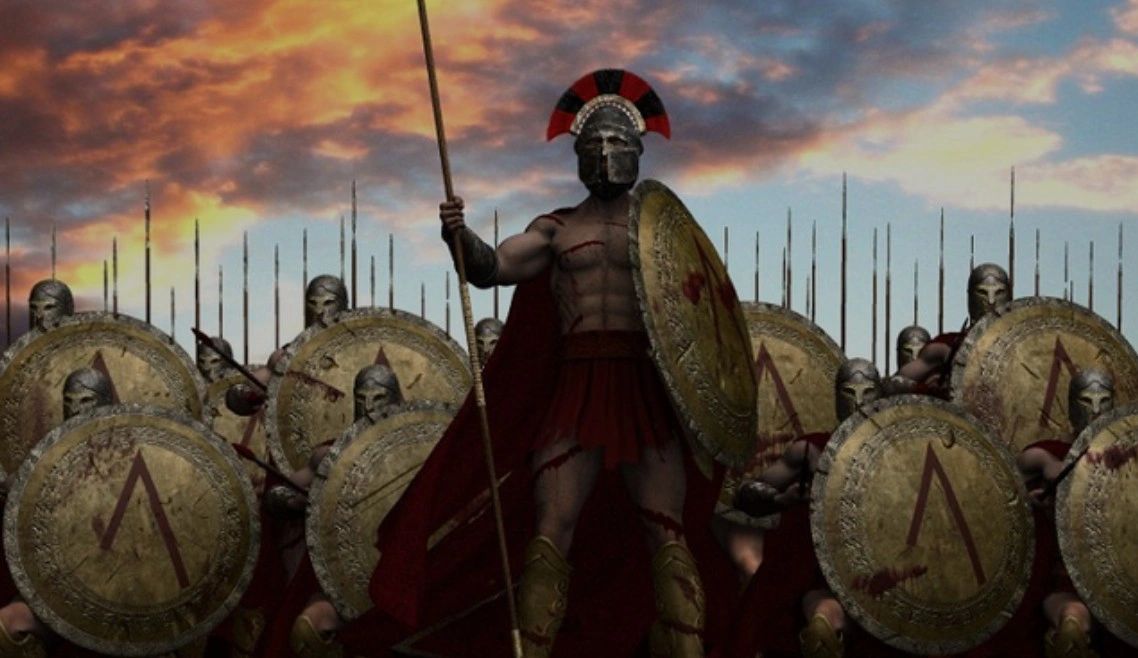
The Battle of Thermopylae, fought in 480 BC at a narrow mountain pass in central Greece, stands as one of the most iconic episodes of classical warfare. The engagement saw a smaller Spartan force, led by King Leonidas I, confront the giant Persian army under King Xerxes I. Though vastly outnumbered, the Greek defenders made excellent use of the terrain to their advantage in a valiant delaying action that has endured in the annals of military history.
Strategically, Thermopylae was meant to be a delaying action to impede the Persian advance into Southern Greece long enough for the other Greek city-states to prepare for a broader defense. Tactically, it showcased how disciplined heavy infantry, namely Hoplites, could resist overwhelming numerical superiority through clever use of geography and cohesion. The battle also bore political and symbolic importance, galvanizing Greek unity in the face of existential threat.
The primary account of the battle comes from Herodotus in The Histories, specifically book VII, which remains the foundational source for modern reconstructions. Supplementing his work are archaeological and interpretive contributions from later historians and modern scholars. Among these, Paul Cartledge’s Thermopylae: The Battle That Changed the World and Christopher Matthew and Mathew Trundle’s anthology Beyond the Gates of Fire provide essential perspectives that question and refine traditional interpretations.
The Battle of Thermopylae was a militarily strategic and culturally transformative event that influenced the outcome of the Greco-Persian Wars and forged a legacy of Western identity centered on courage, sacrifice, and resistance to tyranny.
Strategic Setting and Context
The second Persian invasion of Greece, led by King Xerxes I, was launched in 480 BCE as a meticulously planned campaign to avenge the earlier Persian defeat at Marathon and assert dominance over the Greek mainland. According to Herodotus, Xerxes’s forces allegedly numbered in the millions, although modern scholarship generally estimates around 200,000 troops.[1] The massive mobilization reflected the Persian strategy of overwhelming force, coupled with psychological warfare intended to intimidate and compel submission from the fragmented Greek city-states.
The Greeks, aware of the existential threat posed by the Persian Empire, responded with a rare display of unity. The Hellenic League was formed, with Sparta appointed to lead the land forces and Athens the naval operations. The narrow mountain pass of Thermopylae, situated between Thessaly and central Greece, was selected as the ideal site to mount a defensive stand. As Paul Cartledge notes, the selection of Thermopylae was not a desperate gamble but a calculated move that exploited Greek familiarity with local terrain to neutralize the Persians’ numerical advantage.[2] The pass, flanked by the Trachinian Cliffs and the sea, forced the invading army into a constricted front, where heavily armored Greek hoplites could hold their line with greater effectiveness.
The strategic timing of the defense also aligned with the naval operations at Artemisium, forming a two-pronged Greek effort to contain the Persian advance. Herodotus emphasizes that the coordination between land and sea was vital, albeit complicated by internal disputes and late arrivals.[3] This tension among allies reflects the persistent fragility of the Greek coalition, even when facing a common enemy.
Brian Todd Carey highlights that Thermopylae was “the first deliberate attempt by a coalition of Greek states to defend collectively against an external threat on a Pan-Hellenic scale,” underscoring the geopolitical importance of the battle.[4] It was both a military and ideological stand, where strategy intertwined with symbolism, and where defeat carried the seeds of future victory.
Forces and Leadership
The Greek coalition at Thermopylae brought together warriors from multiple city-states forming a unified defensive line against the looming Persian threat. The core of the force numbered around 7,000 men at its peak, including Phocians, Thebans, Arcadians, Corinthians, and others. However, the most famous contingent was the 300 Spartans handpicked by King Leonidas — seasoned veterans who had all fathered sons, ensuring their lineage would survive them.[5] This selection was steeped in Spartan ideals: duty, discipline, and the belief that true citizenship required sacrifice for the state.
Leonidas’s command extended beyond tactical leadership; it embodied Spartan civic virtue. Rather than a reckless suicide mission, his choice to remain behind with his personal guard and a handful of allies was a deliberate act of moral leadership, calculated to inspire unity among the Greeks. As Paul Cartledge observes, Leonidas’s decision to die at Thermopylae was “an act of consciously chosen martyrdom, undertaken in the belief that it would ignite a larger flame of resistance.”[6] By standing his ground, Leonidas transformed a defensive stand into a legend.
Brian Todd Carey emphasizes the cohesion and professionalism of the Greek hoplites, particularly the Spartans, describing them as the product of a “social and military system designed to produce elite soldiers whose loyalty to the polis outweighed their fear of death.”[7] The phalanx formation, with interlocked shields and overlapping spears, was ideal for the narrow confines of Thermopylae, allowing heavily armored infantry to maximize their defensive strength. Leonidas’s ability to coordinate this diverse coalition and maintain morale in the face of overwhelming odds speaks to his strategic acumen and the respect he commanded.
In stark contrast, Xerxes I led a polyglot army drawn from the farthest reaches of the Achaemenid Empire — estimates range from 100,000 to 250,000 troops.[8] While Herodotus famously exaggerates the number to over two million, modern historians agree that Xerxes’s force was the largest ever seen in Greece up to that time. Despite this advantage, Persian military doctrine was often ill-suited to the rugged Greek terrain. Light infantry, archers, and cavalry, effective on open plains, were stifled in the narrow mountain pass, and Xerxes’s reliance on sheer numbers revealed a critical miscalculation.
Ernle Bradford contrasts the leadership styles of the two kings, noting that Xerxes “trusted in spectacle and coercion,” believing that the sheer might of his empire would bring about swift submission.[9] Unlike Leonidas, who shared hardship and danger with his men, Xerxes remained aloof, issuing orders from a gilded throne set up to observe the battlefield. This detachment, Bradford argues, fostered a sense of distance between Xerxes and his troops, weakening morale and cohesion.[10]
Moreover, while Xerxes did possess competent generals, such as Hydarnes and Mardonius, his tendency to dismiss tactical counsel contributed to the costly frontal assaults on the Greek position. Herodotus recounts that the Persian Immortals, an elite unit, were deployed to break the Greek line but were repelled with heavy losses, their famed prowess diminished in the confined space.[11] Only through the betrayal of Ephialtes, who revealed a hidden path around the Greek position, was Xerxes able to execute a successful flanking maneuver.
Thus, the Battle of Thermopylae was not only a confrontation of armies but of ideologies and leadership styles. Leonidas forged strength through sacrifice and solidarity. Xerxes commanded from above, relying on volume and intimidation. The outcome, a tactical defeat for the Greeks but a strategic and moral victory, owed much to this profound contrast in leadership philosophy.
Tactics and Geography
See also: Map of Thermopylae (emersonkent.com)
Thermopylae’s terrain was its first and greatest ally. The narrow coastal road—hemmed in by the mountains of Callidromus on one side and the Malian Gulf on the other—formed a natural bottleneck that neutralized the advantages of the massive Persian army. This choke point prevented Xerxes from deploying his cavalry or outflanking the Greeks in the early stages of the battle. Forced to funnel their troops into a narrow front, the Persians could not capitalize on their numerical superiority and were repeatedly met by the resolute wall of bronze that was the Greek hoplite phalanx.
Herodotus recounts how the Greeks strategically rotated their units, allowing fresh troops to cycle in while others rested — a level of battlefield coordination that maximized endurance over the three-day engagement.[12] This method of rotation enabled the Greeks to maintain a consistent defense without exhausting their front line, a tactic unusual for its time and highly effective under the circumstances.
The phalanx formation itself was perfectly suited to their terrain. Paul Cartledge highlights the role of the aspis shield and dori spear, describing how the “bristling wall of spears…presented the advancing Persians with an unbreakable hedge of iron.”[13] In such confined space, where maneuver was limited and cohesion mattered most, the hoplite line was virtually impenetrable. Each hoplite’s shield protected not only himself but his neighbor to the left, reinforcing the collective nature of Greek warfare and the psychological strength it offered.
The Greeks also employed staggered defensive lines and controlled retreats — maneuvers designed not merely to resist but to exhaust. According to Ernle Bradford, these movements “reflected a high level of tactical planning and battlefield control, especially remarkable given the ad hoc nature of the coalition.”[14] This was not a mindless last stand; it was a carefully staged defense designed to buy time and bleed the enemy.
Matthew and Trundle suggest that these tactics foreshadowed the later principles of defense-in-depth, layered resistance intended to delay and disrupt an enemy’s advance while minimizing losses.[15] They emphasize that, while the Greeks lacked formal doctrines akin to modern operational planning, their instinctive use of terrain, force concentration, and engagement control exhibits a tactical sophistication not typically credited to classical-era coalitions.
Modern military theorists often point to Thermopylae as an early case study in asymmetric defense; how a small, disciplined force can resist and frustrate a far larger adversary by exploiting terrain and cohesion. As Matthew and Trundle succinctly put it, “the Spartans did not hold the pass because of numbers, but because they understood the nature of the ground, the psychology of the enemy, and the strength of unity.”[16]
The Last Stand
The turning point at Thermopylae came through betrayal. A local named Ephialtes revealed to Xerxes a hidden mountain path known as the Anopaea, which bypassed the Greek position. Herodotus, our primary source, describes the traitor in no uncertain terms, naming him explicitly and noting that his infamy would be remembered long after his death.[17] This path enabled the Persians to outflank the Greek position, threatening encirclement and rendering the choke point defense untenable.
Upon learning of the impending encirclement, Leonidas made a fateful decision. He dismissed most of the Greek coalition, retaining only the three hundred Spartans, seven hundred Thespians, and four hundred Thebans. Herodotus records that the Thebans were likely compelled to remain as hostages to loyalty, while the Thespians volunteered to stay and fight to the end.[18] This final act of defiance transformed the battle from a delaying action into a legendary last stand.
The combat that followed was desperate and brutal. Herodotus recounts that “they fought with their swords, if they had them still, and with their hands and teeth” once their spears were broken.[19] Such imagery, though stylized, captures the visceral nature of the final clash, an act of resistance elevated to myth. Paul Cartledge notes that this stand was not only tactically futile but symbolically profound, writing that “Leonidas’s refusal to surrender or flee became a moral foundation stone of Greek unity and resolve.”[20]
Leonidas himself fell in the thick of combat. The Greeks, determined to retrieve his body, launched several furious counterattacks. Herodotus describes three attempts to recover the fallen king’s corpse, each more savage than the last.[21] In their final moments, the defenders encircled themselves atop a small hillock, resisting wave after wave of Persian assault until they were overwhelmed by missile fire. Archaeological investigations at the site, including findings of massed weapon fragments and scorched bones, lend credence to Herodotus’s narrative.[22]
Bradford eloquently interprets this final resistance not as a military failure but a cultural and moral triumph. “The Spartans at Thermopylae,” he writes, “died not because they were trapped, but because they refused to abandon their post. They made of death a weapon.”[23] Theirs was a sacrifice that transcended tactics; it was a defiant affirmation of Greek ideals of autonomy, courage, and unyielding duty to the polis.
Matthew and Trundle frame this sacrifice as a kind of performative warfare, an event intended not only to delay the enemy but to inspire the allies.[24] They argue that Thermopylae became a model for later acts of martyrdom in the Greek imagination, from Plataea to the narratives surrounding Athens during the Peloponnesian War. The last stand was thus not only an ending but a beginning. A myth in the making.
Perspectives and Interpretations
While Herodotus’s narrative has long determined the understanding of Thermopylae, modern historians have added critical nuance by reassessing both the events and the meanings attached to them. As the “Father of History,” Herodotus preserved invaluable detail, but he was also a product of his time, relying heavily on oral traditions, patriotic embellishment, and Athenian cultural framing. His depiction of Thermopylae — heroic Spartans versus faceless Persians, glory through death, and treachery punished by infamy — resonates deeply but requires cautious unpacking.
In the anthology Beyond the Gates of Fire, Matthew and Trundle compile a range of modern interpretations that challenge these conventional binaries. They interrogate the long-held Spartan-centric lens and bring attention to often overlooked contingents such as the Thespians, Phocians, and Thebans.[25] These perspectives argue that Thermopylae was more than a Spartan last stand — it was a coalition effort with complex political and regional dynamics.
Jeffrey Rop offers a pointed critique of the standard narrative concerning the Phocians, who were charged with guarding the mountain pass. Herodotus implies that they failed through cowardice or negligence, a claim long accepted in popular accounts. Rop, however, suggests that this portrayal is more reflective of scapegoating than fact. Drawing from alternate primary materials and close textual analysis, he argues that the Phocians were likely overwhelmed by the Persian maneuver, not derelict in their duty.[26] “Herodotus’s narrative,” Rop writes, “tells us more about Athenian attitudes than about Phocian actions.”[27] This reframing complicates the story and challenges simplistic interpretations of loyalty and betrayal.
Cartledge, too, critiques Herodotus’s romanticism, acknowledging that while Herodotus preserved the core of the event, his narrative was shaped by cultural archetypes — especially the heroic ideal.[28] Cartledge points to the repeated emphasis on noble sacrifice and the vilification of those who survived as evidence of an underlying moral agenda, one intended to instruct and inspire more than to record.
Matthew and Trundle take this argument further, positioning Thermopylae as a deliberately mythologized episode, its memory harnessed for political cohesion in postwar Greece.[29] They examine how the story was retold in rhetorical contexts, dramatized in literature, and immortalized in public monuments such as Simonides’s famous epigram: “Go tell the Spartans, you who passeth by, That here, obedient to their laws, we lie.”[30] The battle, they argue, became a cultural template: a moment of constructed glory used to reinforce Hellenic identity and civic virtue.
Such historiographical debates deepen our understanding of Thermopylae. They invite scholars and readers alike to disentangle the layers of narrative accretion from the events themselves. What emerges is not just a better picture of what happened in 480 BCE, but a richer awareness of how history is shaped — by the storyteller as much as the story. As modern historiography reminds us, memory is not static; it is forged in the crucible of politics, culture, and time.
Culture and Strategic Legacy
Thermopylae’s impact far outlived its immediate military outcomes. The death of Leonidas and his men became a legend retold across centuries, a rallying cry for unity and defiance in the face of overwhelming odds. For the ancient Greeks, their sacrifice symbolized the strength of collective identity over imperial submission. That ideal of standing firm regardless of the cost was enshrined not just in memory, but in the very ethos of Greek resistance during the remainder of the Persian Wars.
Paul Cartledge argues that Thermopylae marked a pivotal shift in Western military ethics. The battle elevated the concept of voluntary self-sacrifice for the public good as a virtue in both civic and martial life.[31] Unlike Homeric warriors who sought glory for personal renown, the Spartans at Thermopylae embraced death as a civic duty, redefining heroism in communal terms. “Their greatness lay not in conquest,” Cartledge notes, “but in refusal to submit, to flee, to be bought.”[32]
Ernle Bradford places Thermopylae within the broader ideological conflict between East and West. He describes it as a “symbolic bulwark against oriental despotism,” portraying the battle as a cultural stand for freedom against tyranny.[33] While this East-West binary has evolved in modern historiography, the theme persists in popular imagination, where the Spartans are cast as timeless defenders of liberty. From Jacques-Louis David’s neoclassical paintings to modern films like 300, Thermopylae’s martial idealism has become cultural shorthand for courage in crisis.
Strategically, the battle demonstrated enduring principles in warfare. By leveraging terrain, morale, and discipline, a smaller, cohesive force was able to delay a vastly larger army. This lesson has resonated through military history—from the Roman legions at the Caudine Forks, to Wellington’s thin red line at Waterloo, to the defense of Bastogne in World War II.[34] Thermopylae proved that leadership, environment, and esprit de corps can sometimes outweigh pure numbers.
Christopher Matthew and Mathew Trundle argue that the battle’s true legacy lies not only in military doctrine but in its political symbolism.[35] Thermopylae became a metaphor for civic virtue, republican resilience, and moral clarity in the face of authoritarian threat. This symbolism was repurposed during the French Revolution, echoed in the speeches of Churchill, and invoked again during the Cold War.[36] As Matthew and Trundle explain, “Thermopylae’s resonance endures not simply because of what happened, but because of what it was made to mean.”[37]
Thus, the legacy of Thermopylae is not just carved into stone at the battlefield or preserved in the pages of Herodotus — it lives on as a mythic reference point, reimagined by each generation that finds itself confronting tyranny, adversity, or the call to sacrifice.
Conclusion
The Battle of Thermopylae endures not because it resulted in victory, but because it transformed defeat into inspiration. Herodotus’s account — enriched by archaeology and challenged by modern scholarship — reveals more than a clash of armies. It presents a layered conflict of values: autocracy against liberty, numbers against discipline, and conquest against conviction. Leonidas and his men did not simply resist a Persian invasion; they defied submission itself.
Their stand at Thermopylae demonstrated that the strategic use of terrain, the cohesion of citizen-soldiers, and the moral authority of leadership could rally a fractured coalition and forge a path toward eventual triumph. Their example resonated beyond military doctrine, instilling ideals of civic sacrifice, martial honor, and resistance to tyranny that became foundational to Western political thought.
In the centuries that followed, Thermopylae’s meaning evolved from a chronicle of valor into a living myth, invoked during revolutions, wars, and crises of identity. It has been immortalized in stone, text, and screen, capturing the imagination of each generation facing its own existential trials. The power of that myth lies not only in what happened in 480 BCE, but in what it has come to represent: the unbreakable resolve to hold the line.
As echoed in modern retelling, when the Persian messenger demanded submission and King Leonidas responded with an unflinching battle cry, he did more than reject servitude — he defined a spirit. “This is Sparta!!!”[38]
Originally published at the live site .