World War I · 1918 ·
Examining the 'Lost Battalion': Who Was to Blame?
On Hill 198 in the Argonne, Major Charles Whittlesey's 308th held its ground for five days surrounded, gassed, and shelled by its own guns. A reckoning with the leaders who put them there.
- Outcome
- Tactical
- Belligerents
- United States vs. German Empire
- Commanders
- Charles W. Whittlesey · Robert Alexander · Nelson Holderman · George McMurtry
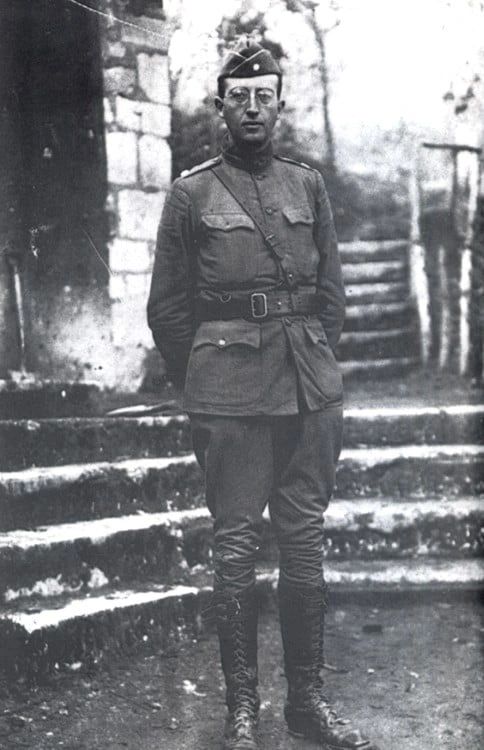
Major Charles Whittlesey’s decision for the 308th Infantry Regiment to hold its ground during the Meuse-Argonne Offensive showcases American grit and perseverance in times of great distress. Surrounded, cut off, and suffering, their stand on Hill 198 is the epitome of American grit and fighting spirit.
The Facts
When America entered the war, it had a standing army of around 127,500 men. Once war was declared, a draft and volunteer force began to rapidly be built. The first division to arrive in France would be the 77th Division. Made of mostly New Yorkers (the city), they trained at Camp Upton located on the northern section of Long Island. The 23,000 men of the 77th were drafted from all walks of life. Some were American-born citizens while others had immigrated from the continent they left. All were ready to fight by the time they arrived in France in March and April 1918.
Once in France they began to train with the British 39th Infantry Division. They learned the bayonet, how to use British machine guns, and trench drills. Of course, just as the opposing forces that had been slugging it out for 4 years at this point, the Americans knew they would just break through the lines to get into some maneuver warfare. This was not to be. By June 1918, the 77th found themselves in what was deemed a quiet sector of the French lines. This was not to be as the Germans gave them a very violent welcome. For the next few months, the 77th would be tested and blooded and generally have a poor showing as a unit.
By the start of the Meuse-Argonne offensive on 26 September 1918, the 77th had seen a change of commanders. General Robert Alexander had taken command of the division in August and, though he was a despised commander, gave the 77th a new life that helped turn the beaten-up division around. General Alexander was a man who started his military life as a private and moved through the ranks. He was described as an abrasive man with a giant chip on his shoulder. In his book Finding the Lost Battalion, Robert Laplander mentions that this attitude comes from having to constantly deal with West Point officers who did not appreciate that his promotions were due to merit. However, his stern demeanor may have not made many friends, but he was able to turn the division around. He did this by starting with his officers and instructing them in what they were going to do, followed more importantly by the why. Then he did this with the NCOs and finally the men.
The Action
The Meuse-Argonne offensive, which would last for 100 days, was meant to break the German lines and finally get into their rear to maneuver. There were many battles, and Americans would distinguish themselves in all sections of the front. However, it was the 308th Infantry Regiment under Major Whittlesey that would be the standout unit for this battle. 2 October 1918 found these men fighting on a section of the front with the aim of taking Hill 198 in the Argonne Forest. During this attack, the French 4th Army was to be on their left and the American 28th on their right. Their orders were to focus on the advance and not to worry about what was going on around them.
Major Whittlesey was a man who followed orders. He would protest if he felt it was not workable, but at the end of the day, he would do what he was ordered to. A lawyer in civilian life, he was a well-respected officer who, while doing staff work, would visit the front lines in the early days of the Expeditionary Force and learn all that he could. Due to losses, he would assume his combat command with the 308th. Here he would lead this melting pot of men into the most desperate fight for the Americans of the First World War.
The 308th Battalion would enter the fight on 2 October with 554 fighting men. They would take their objective after bloody fighting and dig in. Unaware that their flanking units had retreated, Whittlesey prepared defenses and sent back word that their objective was secure. When he found that they were alone, he decided to not give up their hard-won victory and fortify. The Germans would surround them and make every effort for the next few days to dislodge the 308th. The Americans were pounded with artillery, gassed, burned alive with flamethrowers. They would even be shelled with their own artillery due to a miscommunicated fire mission, only to be saved by a carrier pigeon named Cher Ami.
This desperate fight would go on until 7 October, when the Germans retreated after repeatedly being denied a win by the 308th. Through the fighting, Whittlesey showed excellent leadership in moving along the lines and having his men see he didn’t quit. This in turn inspired his officers and NCOs to follow suit and never give up. American perseverance is on full display in this fight and they would find out they were famous before the fight was over thanks to embedded journalists with the 77th. Their reporting of the “Lost Battalion” would ignite the imaginations of the country and make the men that fought on “Hell’s Half Acre” famous. Major Charles Whittlesey, Captain Nelson Holderman, and Captain George McMurtry would earn the Congressional Medal of Honor in this fight.
554 men went into the fight but only 194 would finish it. All of the survivors were sick from gas, starving, dehydrated and filthy. As the men of the 82nd Division broke through the German lines to rescue these men, many noticed the smell that awaited them as they approached the carnage that they found on Hill 198. They were greeted by a hellscape of bloodied survivors, dead and wounded. However, the survivors walked off the hill, and Major Whittlesey with them.
Analysis
As with many First World War battles, this was a desperate fight with heavy loss and many problems. Communications were terrible. The fact that they had to depend upon carrier pigeons is just a horrific way to fight a war. It makes one appreciate the evolution of wireless communications. Coordination therefore was also lacking. In some ways, one cannot argue that Alexander’s idea of “just push forward, don’t worry about your flanks” has its merits, but it was a failure to learn any lessons from every other battle of the war.
Training also failed, as the 77th never actually trained as a whole division, let alone with the other divisions they would fight with. There also was a lack of combined arms training so that the ability to adapt to artillery or infantry delays was non-existent on the battlefield. There was also an interesting amount of American ego. In most cases, it is what makes Americans such fierce warriors, but it also leads to a hell of a lot of trouble.
Leadership was also a failure. General Alexander, like many of his peers, was accepting of massive losses to get the job done. Whittlesey’s blind following of orders and not paying attention to the whole picture was a failure of his command which put his men in the position they found themselves in. Also, his defiance of retreating with the desire to hold his position can also be viewed as a failure.
Opinion
It is my opinion that the lion’s share of the blame lay upon General Alexander and the rest of high command. In his quest to prove he was as good as his West Point peers, he wasted lives in the search of glory. While Whittlesey holds some blame, I cannot in good conscience fault a man who follows orders, then decides they paid too high of a price to give up the ground.
Laplander repeatedly paints Whittlesey as a great staff officer but not a combat commander. I passionately and wholeheartedly disagree. He was smart enough to visit the front to see what was going on before he assumed command, he attempted to learn lessons, and earned the respect and admiration of his men. He showed some of the greatest leadership I have ever researched and is well deserving of his Medal of Honor. It is a shame that such a great and humble man took his own life, as so many of America’s heroes tend to do.
To be fair, high command for all the countries that fought in this war had a firm belief that lives were cheap in their race for glory. With that in mind, Alexander was not wrong; however, when men such as Whittlesey told him that his plans were untenable, he should have listened. His ego is what caused the actions of the 308th and their losses on “Hell’s Half Acre.”
I hope you enjoyed this post.
Bibliography
Durr, Eric. “WWI Move of 77th Division of New York Draftees Was Not So Secret in April 1918.” Army Reserve, 6 August 2018.
Larsen, Ellora. “Cher Ami.” National Museum of the United States Army.
Keegan, John. The First World War. New York: Random House, 1998.
Kratz, Jessie. “The Lost Battalion of World War I.” Pieces of History, 21 July 2017.
Laplander, Robert J. Finding the Lost Battalion. New York: Lulu, 2006.
“Major Charles W. Whittlesey and the Lost Battalion.” Congressional Medal of Honor Society.
McKeough, Arthur. The Victorious 77th Division, New York’s Own. New York: John H. Eggers Publishing Co., 1918.
Originally published at the live site .